Best Next.js Ecommerce Templates in 2026 — Compared & Ranked
Looking for the best Next.js ecommerce template in 2026? We compare the top options — free and paid — so you can launch your store faster without building from scratch.
Why Use a Next.js Ecommerce Template in 2026?
Building a custom ecommerce frontend from scratch in Next.js takes weeks. A good template gives you a production-ready starting point — pages, components, cart logic, mobile navigation, and design system all done — so you can focus on connecting your backend and customising for your brand instead of reinventing every wheel.
In 2026, the Next.js ecosystem has matured significantly. The App Router is now stable, React Server Components are mainstream, and Tailwind CSS v4 has shipped. The best Next.js ecommerce templates have caught up — but many older options have not. This guide focuses only on templates that use modern Next.js architecture and are worth your time in 2026.
What to Look for in a Next.js Ecommerce Template
App Router, Not Pages Router
If a template is still using the legacy Pages Router, it is already outdated. The App Router brings React Server Components, nested layouts, streaming, and better performance out of the box. Any template you buy in 2026 should be App Router first.
TypeScript Throughout
A Next.js ecommerce template without TypeScript is a liability. TypeScript catches bugs at build time, makes the codebase easier to navigate, and is now the industry standard for any serious Next.js project. Check this before buying.
Decoupled Data Layer
The best templates separate UI from data. Products, collections, and content should load from files or an API layer that is easy to swap. A template that hardcodes Shopify SDK calls throughout every component is difficult to repurpose. Look for a clean data layer you can connect to any backend.
Mobile-First Design
Over 60% of ecommerce traffic is mobile. A template built desktop-first will always feel clunky on phones. Check the mobile experience — not just that it is responsive, but that it is genuinely good on a 390px screen.
Real Pages, Not Just a Homepage
Many templates ship with a beautiful homepage and almost nothing else. A production-ready ecommerce template needs at minimum: collection page, product detail page, cart, checkout, search, account pages, and about/contact. Count the pages before you buy.

Choosing the right Next.js ecommerce template saves weeks of development time in 2026.
The Best Next.js Ecommerce Templates in 2026
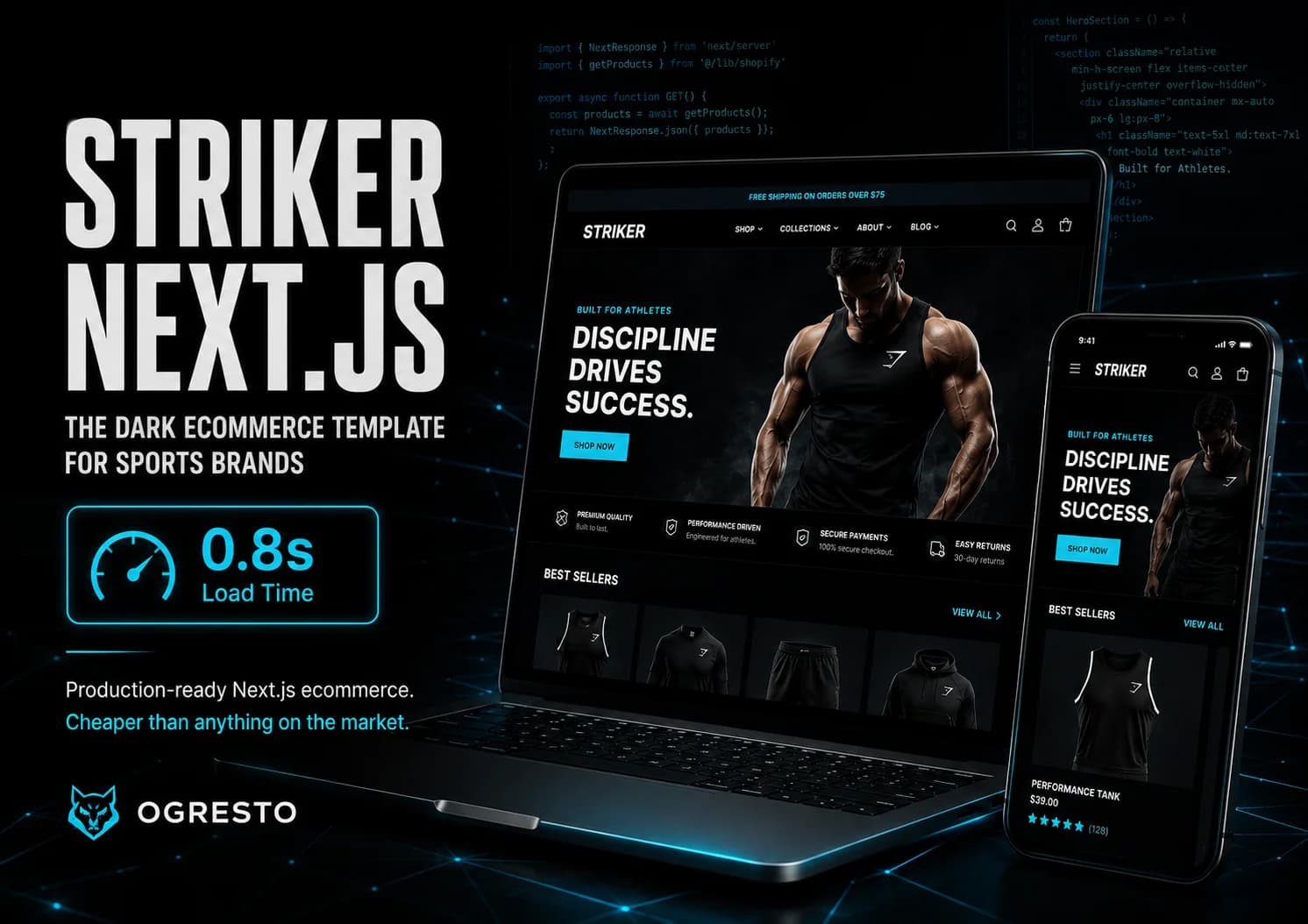
1. Striker by Ogresto — Best Dark Theme for Sports, Fashion & Lifestyle
Price: $79 | Best for: Sports brands, streetwear, fashion, fitness, electronics, lifestyle D2C
Striker is a premium dark Next.js ecommerce template built on Next.js 16 App Router with TypeScript throughout and Tailwind CSS v4. It was designed for brands that want a bold, high-energy online presence — not another pale, minimalist storefront that looks identical to every other store.
What makes Striker stand out:
- Next.js 16 App Router + TypeScript — fully modern architecture
- 10+ production-ready pages including homepage, collection, product detail, cart, wishlist, account dashboard, search overlay, about, and contact
- AJAX cart drawer that works across all pages without breaking on React navigation
- Mobile bottom navigation bar fixed outside overflow containers — no clipping issues
- Fully decoupled data layer — swap demo data for Shopify Storefront API, WooCommerce, Medusa, or any custom backend
- Tailwind CSS v4 with a custom dark design system — fire gradient accents, condensed bold typography, signature black palette
- Custom animated cursor, scroll-reveal animations, infinite marquee strip
- Vercel-ready — zero config, one command deploy
- No heavy dependencies — just Next.js and Tailwind
- 30 days support + free lifetime updates
Striker was built by Ogresto — a development agency that builds production stores for real clients. It is not a portfolio side project or a Themeforest reskin. The codebase reflects real production requirements.
Who it is for: Sports brands, streetwear labels, gym apparel companies, fitness supplement stores, electronics retailers, and any D2C brand with a bold visual identity.
Who it is not for: Brands that want a light, minimalist aesthetic. Striker is deliberately dark and bold.
Ready-built headless frontend
Striker Next.js — Shopify Storefront API Ready
Skip months of frontend work. Connects to your Shopify store via Storefront API out of the box — product pages, cart, wishlist, all built in Next.js 16.
Next.js 16 App Router · TypeScript · Tailwind v4 · One-time $79
2. Next.js Commerce by Vercel — Best Free Option
Price: Free | Best for: Developers who want a Shopify-connected starting point
Vercel's official Next.js Commerce template connects directly to Shopify Storefront API, uses App Router, and is maintained by the Vercel team. The code quality is excellent and it is a solid foundation for Shopify headless builds.
The limitations are real though. Next.js Commerce is not a theme — it is a minimal starter. There is almost no visual design, limited UI components, and it requires significant development work before it looks like a finished store. Great free foundation for developers. Not suitable if you need something close to production-ready.
3. Ciseco by Themeforest — Best for Large Catalogues
Price: $59 | Best for: Multi-category stores with large product catalogues
Ciseco is one of the more popular paid Next.js ecommerce templates on Themeforest. It ships with many pages, multiple homepage variants, and decent component coverage. For stores with complex catalogues, the page variety is useful.
The downsides are typical Themeforest issues — the codebase shows its age, earlier versions use the legacy Pages Router, the design is generic light-mode, and support response times are inconsistent. It works, but not a codebase you would enjoy maintaining long term.
4. NextMerce — Best Free Minimal Option
Price: Free | Best for: Developers learning Next.js ecommerce patterns
NextMerce is a free open-source Next.js ecommerce boilerplate on GitHub. It covers the basics — product listing, product detail, cart — and is useful as a learning resource. It is not production-ready — the design is purely functional, no account system, no wishlist, and the mobile experience needs work.

Striker — the only premium dark Next.js ecommerce template built on Next.js 16 App Router.
Comparison Table
| Template | Price | Next.js | App Router | TypeScript | Pages | Best For |
|---|---|---|---|---|---|---|
| Striker (Ogresto) | $79 | 16 | ✅ Yes | ✅ Yes | 10+ | Sports, fashion, lifestyle |
| Next.js Commerce (Vercel) | Free | 15 | ✅ Yes | ✅ Yes | 4 | Shopify headless, developers |
| Ciseco (Themeforest) | $59 | 13-14 | ⚠️ Partial | ⚠️ Partial | 15+ | Large catalogues |
| NextMerce | Free | 14 | ✅ Yes | ✅ Yes | 3 | Learning only |
Which Next.js Ecommerce Template Should You Choose?
You want to launch a sports, fashion, or lifestyle brand fast
Striker is the right choice. It is the only premium dark Next.js ecommerce template on this list built with modern App Router architecture, TypeScript, and a complete set of production pages. See the Striker live demo →
You are building a Shopify headless store and have a developer
Start with Next.js Commerce (free). It handles the Shopify API connection cleanly and the Vercel team keeps it updated. You will need to invest significant development time on the design layer.
You need a large number of page variants
Ciseco covers this use case reasonably well despite its dated codebase. Verify the App Router status of the version you are downloading before purchasing.
You are learning Next.js ecommerce development
NextMerce is a free, clean starting point to understand the patterns. Not for production use but valuable for learning.
The Real Difference Between Free and Paid Templates
Free Next.js ecommerce templates give you architecture and patterns — they are developer tools. Paid templates give you a finished design, complete page set, tested components, and ongoing support. The question is not which costs less — it is how much developer time the free option costs to get to the same result.
A developer spending 40 hours building what a paid template provides out of the box costs significantly more than the template price. For teams moving fast, a quality paid Next.js ecommerce template almost always has a positive ROI.
Final Recommendation
For most brands launching an ecommerce storefront in 2026 — especially in sports, fashion, streetwear, fitness, or lifestyle — Striker by Ogresto is the most complete, modern, and production-ready option available. It is built on the latest Next.js architecture, ships with everything you need to go live, and is backed by an active development team.
For developers who specifically need a Shopify headless connection and are comfortable building the visual layer themselves, the free Next.js Commerce by Vercel is the right technical foundation.
View the Striker Next.js ecommerce template — live demo and pricing →
FAQ — Next.js Ecommerce Templates
The best template depends on your niche and technical requirements. For sports, fitness, and streetwear brands — Striker Next.js offers a production-ready dark athletic aesthetic with Shopify Storefront API integration from $79. For general ecommerce, Next.js Commerce from Vercel is a solid free starting point.
Yes. Next.js templates require React and Next.js knowledge to set up and customise. They're not no-code tools. If you're not technical, a Shopify theme is a better choice — installs without code and customises through a visual editor.
Different tools for different needs. Next.js templates give you complete frontend freedom and maximum performance potential but require a developer. Shopify themes are faster to launch, require no coding, and include hosted infrastructure. See our full Shopify vs Next.js comparison.
Yes. Templates built with Shopify Storefront API compatibility — like Striker Next.js — connect directly to your Shopify store for products, inventory, cart, and checkout while using Next.js as the frontend.
Free options include Next.js Commerce and several open-source starters. Premium templates range from $49-$200. Striker Next.js is $79 — a one-time purchase with no recurring fees.
Discussion
Join the conversation