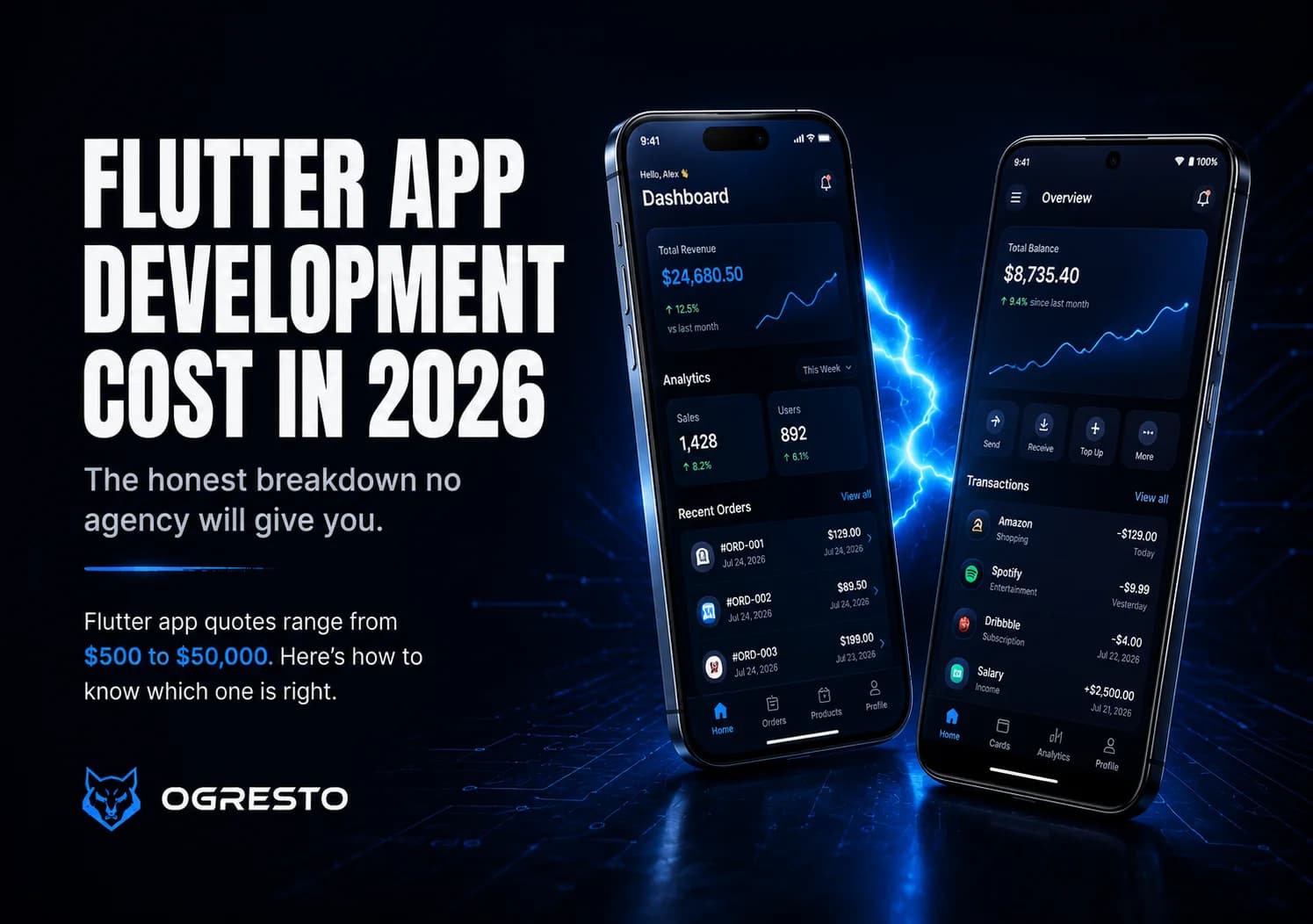
Flutter vs React Native in 2026 — After Building Real Apps, Here is the Truth
Flutter or React Native for your mobile app in 2026? We have built with both in production. Here is the honest comparison — performance, developer experience, ecosystem, and which one to choose for your project.
The Short Answer
For most new mobile app projects in 2026 — choose Flutter. Not because React Native is bad, but because Flutter consistently delivers better performance, a more predictable development experience, and genuinely native-feeling apps on both iOS and Android from a single codebase.
That said, the right choice depends on your specific situation. This comparison is based on building production apps with both frameworks — not benchmarks or toy examples.

Both frameworks are capable. The right choice depends on your team and project requirements.
What Are Flutter and React Native?
Both are cross-platform mobile frameworks that let you build iOS and Android apps from a single codebase — instead of writing separate Swift/Objective-C apps for iOS and Kotlin/Java apps for Android.
Flutter — built by Google, uses the Dart programming language. Renders everything using its own graphics engine (Skia/Impeller) — it does not use native UI components at all. This is why Flutter apps look and feel identical on iOS and Android.
React Native — built by Meta (Facebook), uses JavaScript/TypeScript. Bridges to native platform components — so a React Native button renders as an actual iOS button on iOS and an actual Android button on Android. This is why React Native apps can feel more native on each platform but also why they can behave inconsistently across platforms.
Performance
Flutter wins on performance consistency. Because Flutter renders everything itself with its own engine, there is no JavaScript bridge overhead. Animations are smooth, scrolling is fluid, and complex UIs perform well on mid-range Android devices — which is critical if your app targets India or emerging markets where users often have devices two or three generations old.
React Native has improved significantly with the New Architecture (JSI/Fabric/TurboModules) but still occasionally shows frame drops on complex animations and older Android devices. The bridge is less of a bottleneck than it was in 2019-2021 but it has not entirely disappeared.
For simple apps the difference is negligible. For apps with complex animations, real-time data, or heavy UI work — Flutter is noticeably smoother.
Developer Experience
This one is close. Flutter's hot reload is excellent. Dart is a clean, typed language that most developers pick up in 1-2 weeks if they know any other typed language. The Flutter SDK is opinionated in a good way — there is usually one clear way to do something, which means less time debating architecture.
React Native's developer experience benefits from the JavaScript ecosystem — if your team already knows React, they can start building immediately. TypeScript support is solid. The massive npm ecosystem means solutions exist for almost any problem. The downside is that JavaScript's flexibility can lead to inconsistent codebases across large teams.
Both have excellent IDE support in VS Code and Android Studio.
Flutter compiles to native ARM code — no JavaScript bridge means better performance on mid-range devices.
Ecosystem and Packages
React Native wins on ecosystem breadth. The npm ecosystem is enormous. Most third-party SDKs release a React Native wrapper alongside their native SDKs. If you need something specific, it probably exists as a package.
Flutter's pub.dev ecosystem has grown significantly and covers most common requirements — payments, maps, analytics, camera, push notifications, social auth. For common use cases it is no longer a limitation. For very niche SDKs you may occasionally need to write a platform channel to call the native SDK directly — which requires Dart and some native code knowledge.
Community and Hiring
React Native has a larger global community given it launched in 2015 versus Flutter's 2018 stable release. There are more React Native developers available to hire globally.
Flutter is growing very fast — Google's backing, a passionate community, and expanding use cases beyond mobile (Flutter for web and desktop) mean the talent pool is growing rapidly. In India specifically, Flutter developers are becoming increasingly common as the framework is heavily taught in developer education programs.
When to Choose Flutter
- You need smooth, consistent performance across iOS and Android
- Your app has complex animations or custom UI components
- You are targeting Indian or emerging market users on mid-range Android devices
- You want to share code across mobile, web, and potentially desktop
- Your team is learning a new framework anyway — Dart is easier to learn than it sounds
- You want predictability — Flutter is more opinionated which reduces decision fatigue
When to Choose React Native
- Your team already knows React deeply and you need to ship fast
- You need a specific third-party SDK that only has a React Native wrapper
- You are building a simple app where performance differences are irrelevant
- You want to share code or developers between a React web app and a mobile app
- The role requires integration with a large existing JavaScript codebase
What We Build With at Ogresto
We use Flutter for all new mobile app projects at Ogresto. The performance consistency, Dart's type safety, and the predictable development experience make it the right choice for the apps we build — from startup MVPs to business tools with complex data requirements.
If you are deciding between Flutter and React Native for your project and want an honest conversation about which fits your specific requirements — our mobile app development service
Building an Ecommerce Frontend? Consider Next.js
If your goal is an ecommerce storefront rather than a native mobile app — Next.js is worth evaluating. Faster to market, SEO-friendly, and with a ready-built template you can launch in days rather than months.
Production-ready Next.js ecommerce template
Striker Next.js — Dark Ecommerce Template
Next.js 16 App Router, TypeScript, Tailwind v4. Shopify Storefront API compatible. Sports, fashion, lifestyle brands.
Unlimited use · One-time $79 · Full source code
Related Reading
Frequently Asked Questions
Generally yes for complex UIs and animations on mid-range Android devices. For simple apps the difference is negligible. Flutter's rendering engine eliminates bridge overhead which is the main source of React Native performance issues.
No. If you know JavaScript, TypeScript, Java, or any C-style language, you can write functional Dart code within a week. Flutter's documentation is excellent and the learning curve is well documented.
Yes. A Flutter project generates native iOS and Android builds. Both can be submitted to their respective stores following standard submission processes.
A focused MVP typically costs Rs.80,000 to Rs.1,50,000. A full-featured app with backend integration starts from Rs.2,00,000. We provide detailed quotes after a discovery session.
Discussion
Join the conversation