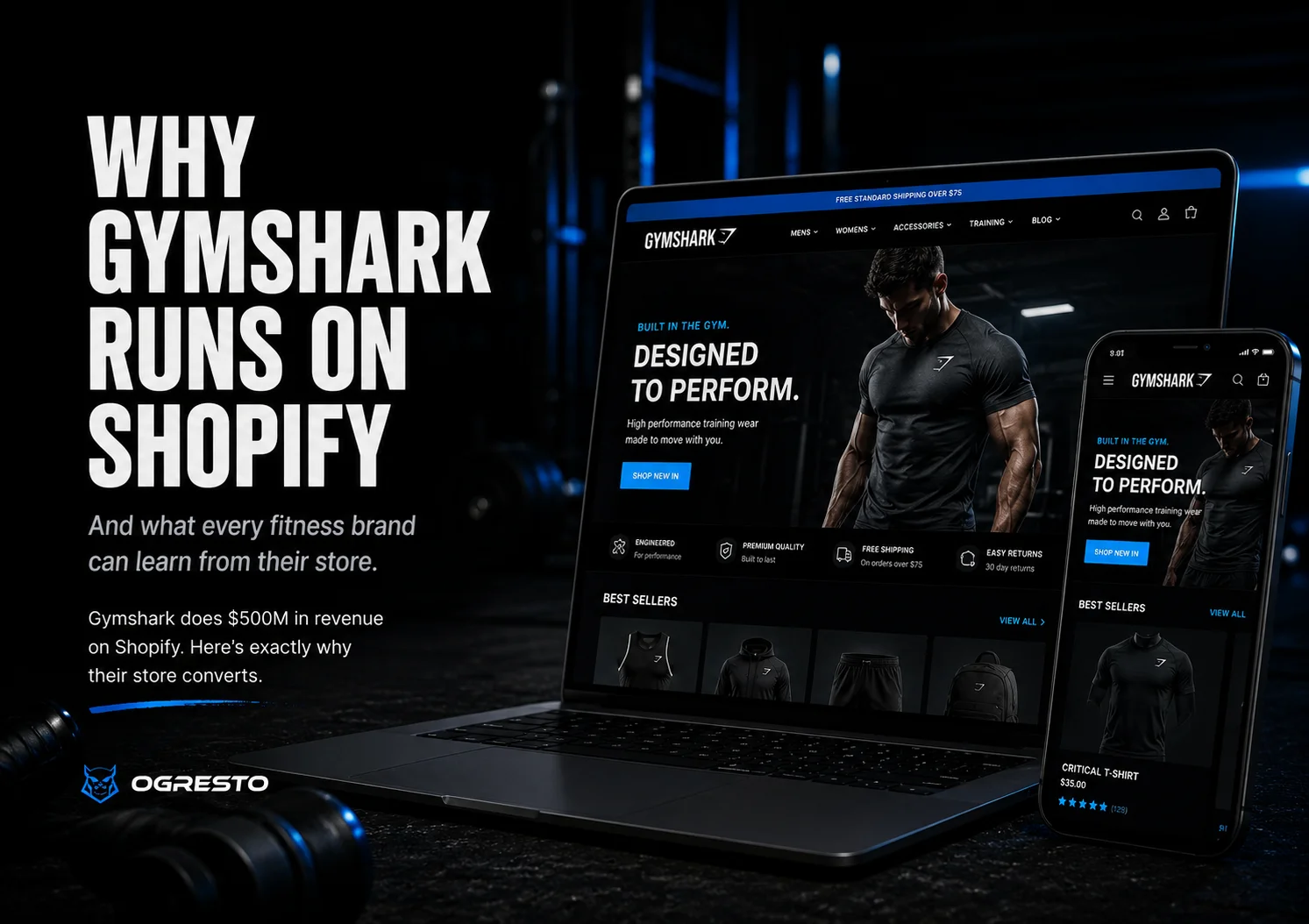
Does Gymshark Use Shopify? Platform, Theme and Store Setup in 2026
Does Gymshark use Shopify? Yes—Shopify Plus is its commerce foundation, while a headless React storefront powers the customer-facing experience. See the platform history and lessons for fitness brands.
Gymshark Uses Shopify at Scale — Here’s How Its Stack Evolved
Gymshark was founded in 2012 and originally launched on Shopify. As the company grew, it moved to Magento (now Adobe Commerce), then returned to Shopify Plus after serious scaling and reliability problems during a major Black Friday event. That migration history matters because Gymshark did not simply stay on one Shopify theme from startup to global scale.
Today, Shopify is the commerce foundation underneath a more composable storefront. Algolia's Gymshark case study documents a headless architecture using Shopify, a ReactJS frontend, Contentful, Algolia, and AWS services. The useful lesson for other fitness brands is therefore not “copy Gymshark's theme,” but separate commerce infrastructure from the customer-facing experience and add complexity only when the business needs it.
What Shopify Plan Does Gymshark Use?
Gymshark uses Shopify Plus as its commerce foundation. Shopify's own case study documents the move from Magento/Adobe Commerce to Shopify Plus after the previous platform struggled with the company's growth and a major Black Friday traffic event.
The accurate history is: Gymshark originally launched on Shopify, moved to Magento as it grew, and later returned to Shopify Plus. You do not need Shopify Plus—or Gymshark's headless architecture—to apply strong ecommerce design principles to a smaller fitness store.
5 Storefront Principles You Can Learn From Gymshark
The useful part of studying Gymshark is the design discipline, not assuming that one colour palette or one theme causes its commercial results. Its current storefront uses a high-contrast brand system, strong campaign imagery, clear hierarchy, and product-first merchandising.
1. High-Contrast Visual System
Gymshark should not be described as using a permanent near-black storefront in 2026. Its current merchandising experience uses strong black-and-white contrast, with light product surfaces alongside darker campaign treatments and imagery when the creative calls for them.
For your own fitness store, the lesson is contrast and consistency—not “make every page black.” A dark native-Shopify theme can be an effective interpretation for the right brand, but it is not a technical or visual copy of Gymshark's current storefront.
2. Athlete-Led Product and Campaign Photography
Gymshark relies heavily on athlete-led product and campaign photography to connect the clothing with training, performance, and identity. The imagery does more than document a garment; it shows the product in the context the target customer cares about.
For smaller brands, this is often more transferable than copying interface details: strong photography can make even a relatively simple Shopify storefront feel much more intentional.
3. Bold, Direct Typography
Gymshark uses strong display typography and clear hierarchy to keep campaign messaging direct and easy to scan. The important principle is not a specific condensed font; it is choosing type that matches an athletic brand and remains readable across devices.
Typography is one of the fastest ways to establish brand character, but it should support product discovery rather than compete with it.
4. Product-First Layout and Clear Hierarchy
Gymshark's storefront keeps products, collections, campaign imagery, and primary actions visually prominent. The transferable lesson is to remove interface noise that competes with shopping tasks.
That does not mean every store should be ultra-minimal. It means promotions, navigation, trust content, and merchandising should have a clear hierarchy instead of all fighting for attention at once.
5. Treat Mobile Shopping as a Primary Experience
Fitness and apparel discovery is heavily connected to social and mobile browsing, so the practical lesson is to design product discovery, navigation, media, and add-to-cart interactions for small screens from the beginning.
A native Shopify theme can do this well without headless commerce. The key is testing real product pages and collections on mobile rather than assuming a responsive desktop layout is enough.
Why Shopify Specifically? Why Not WooCommerce or a Custom Build?
Gymshark evaluated their options. At the scale they were operating, a custom-built ecommerce platform would have required a large engineering team to maintain infrastructure, handle security patches, manage checkout reliability, and keep up with payment gateway integrations. That's not a small investment.
Shopify handled all of that infrastructure. The Gymshark team could focus entirely on product, marketing, and customer experience — the things that actually differentiate their brand — rather than maintaining servers and debugging payment flows.
WooCommerce was eliminated because of reliability at scale. Flash sales — which Gymshark runs regularly — require infrastructure that can handle sudden spikes in traffic without crashing. Shopify's architecture is built for exactly this. WooCommerce on a standard hosting setup is not.
What Gymshark's Store Teaches Us About the Shopify vs Custom Build Debate
There's a recurring debate in ecommerce about whether to build a custom store or use Shopify. Gymshark's journey answers it clearly for most fitness brands.
At under $1M in annual revenue, the operational overhead of a custom build makes no sense. Shopify gets you to market faster, cheaper, and with enterprise-grade infrastructure you couldn't afford to build yourself.
At larger scale, the architecture question becomes more nuanced. Gymshark did not merely “explore” headless commerce: Algolia documents its move to a headless architecture using Shopify as the commerce foundation, a ReactJS frontend, Contentful for content, Algolia for search and navigation, and AWS services. That is different from running a conventional Shopify Liquid theme.
For the vast majority of fitness brands, the answer is: start on Shopify, nail the design, nail the marketing, and scale. You can always add complexity later when revenue justifies it.
How to Get the Gymshark Look on Your Shopify Store
You do not need Gymshark's headless stack to borrow useful storefront principles. High contrast, bold hierarchy, athlete-led photography, clear merchandising, and strong mobile usability can all be implemented in a native Shopify Online Store 2.0 theme.
What you need:
Choose a visual direction that fits your own sports or fitness brand. Gymshark's current storefront is not a permanently dark theme. If your brand specifically benefits from a darker, more aggressive athletic treatment, a purpose-built dark Shopify theme can deliver that direction without pretending to be Gymshark's actual frontend.
High-quality product photography. A great theme with mediocre photography will still underperform. Invest in photography that shows your products in use, with proper lighting, on athletic models. This is the single highest-ROI investment a fitness brand can make.
Bold, condensed typography. Your theme should use the same category of font that high-performance sports brands use — Bebas Neue, Barlow Condensed, or similar. Thin, delicate fonts kill the athletic energy immediately.
Gymshark-inspired athletic energy, native Shopify architecture
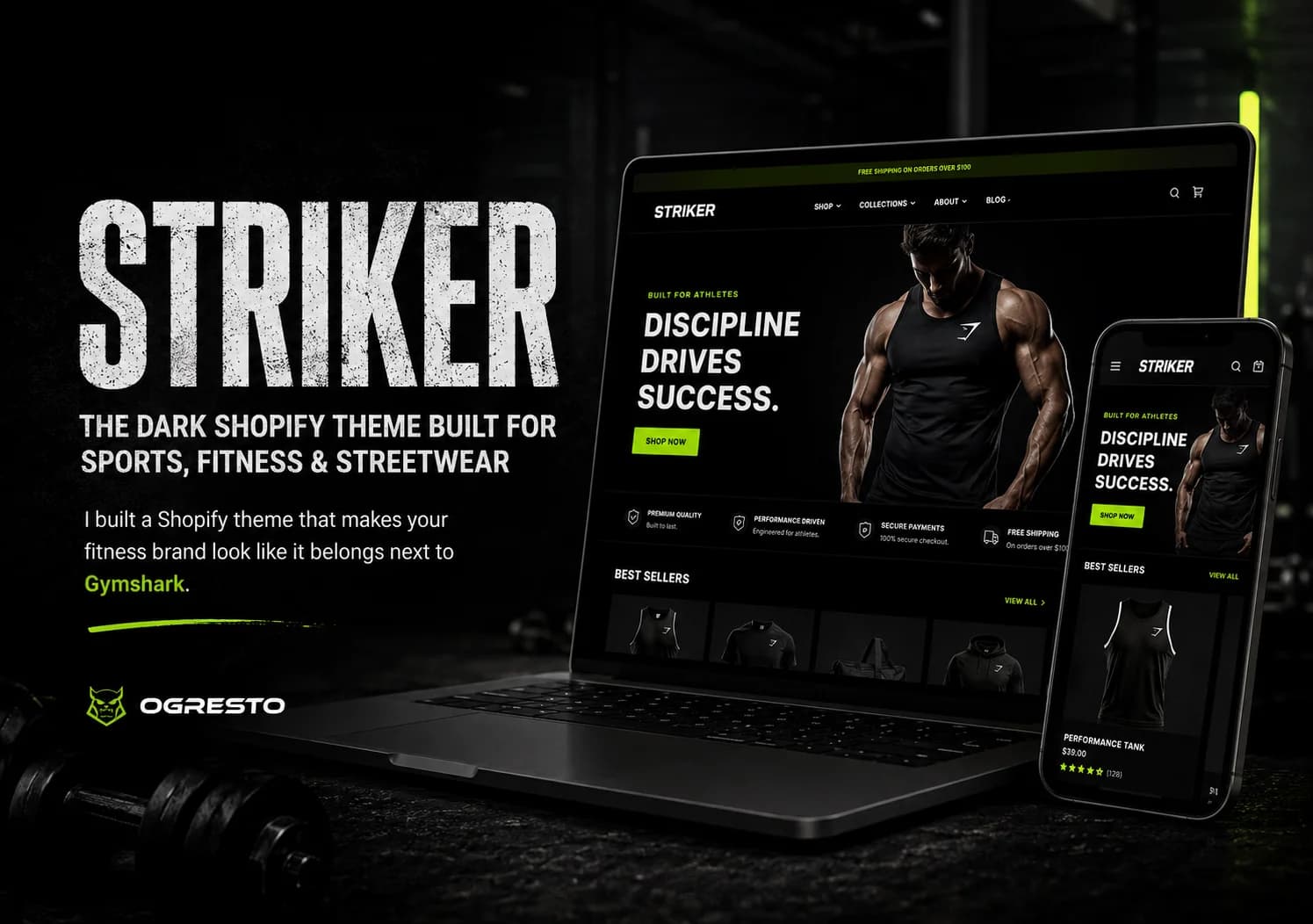
Striker — Dark Shopify Theme for Sports Brands
A purpose-built Shopify 2.0 theme for brands that want a darker athletic direction across sports, gym, fitness, and streetwear.
Shopify 2.0 · Unlimited use · One-time purchase
We built Striker for fitness, sports, and streetwear brands that want a darker high-energy interpretation of modern athletic ecommerce without commissioning a headless frontend.
Striker is a native Shopify Online Store 2.0 theme with dark backgrounds, bold typography, full-bleed imagery, and product-focused layouts. It does not reproduce Gymshark's headless React architecture; it gives smaller merchants a different technical route to a strong athletic storefront.
The Bottom Line — What Gymshark Proves
Gymshark proves that platform choice matters less than design execution and marketing. They succeeded on Shopify not because Shopify is magic, but because they built a store that communicates premium, performs fast, and converts visitors into customers with a deliberate and consistent aesthetic.
The good news for every fitness brand reading this: the playbook is documented, the aesthetic is replicable, and the tools to execute it are accessible. You don't need Gymshark's budget. You need Gymshark's design principles.
High contrast. Athlete-led photography. Bold hierarchy. Product-first merchandising. Strong mobile usability. Those principles are more useful than copying a particular background colour or technology stack.
Related Reading
FAQ — Gymshark and Shopify
Yes. Shopify Plus remains the documented commerce foundation for Gymshark. Its customer-facing architecture is headless rather than a conventional Shopify theme: Algolia documents Shopify with a ReactJS frontend, Contentful, Algolia, and AWS services.
Gymshark should not be described as using a downloadable or conventional Liquid “Shopify theme” for its documented storefront architecture. It uses a custom headless React frontend with Shopify underneath for commerce. Striker is a separate native-Shopify theme that can create a high-energy fitness aesthetic; it is not Gymshark's theme or technology stack.
Yes. Gymshark's own migration history shows that Shopify can serve as the commerce foundation for a fitness brand at very large scale. Smaller brands can use the same core commerce platform without adopting the same enterprise architecture.
The cost depends on whether you use a native theme, custom theme development, or a headless frontend. Shopify plan pricing also varies by market and billing term, so verify current pricing on Shopify's official pricing page. For most smaller brands, photography, merchandising, and theme implementation matter more than copying Gymshark's enterprise stack.
Yes. The core elements of Gymshark's aesthetic — dark theme, bold typography, full-bleed imagery — are available in purpose-built Shopify themes. Striker was built specifically for this.
Discussion
Join the conversation