Next.js vs React for Ecommerce in 2026 — Which Should You Choose?
Next.js vs React for ecommerce — what is the real difference, which one is right for your store, and when does each one actually make sense? An honest comparison from developers who have built both.
The Short Answer
For ecommerce in 2026 — use Next.js. Not because React is bad, but because Next.js is React with everything ecommerce needs already solved: server-side rendering, SEO, routing, image optimisation, and API routes. Building an ecommerce store with plain React means solving all of those problems yourself.
That said, the longer answer matters — because there are specific situations where plain React makes sense, and understanding the difference will save you from making an expensive architectural decision based on a simplistic comparison.
What Is the Actual Difference Between Next.js and React?
React is a UI library. It renders components in the browser. That is all it does — and it does it very well. Everything else — routing, data fetching, server rendering, image optimisation, deployment — you build or bring yourself.
Next.js is a framework built on top of React. It handles routing, server-side rendering, static generation, API routes, image optimisation, font loading, environment variables, and deployment configuration out of the box. You still write React components. You just do not have to wire up all the surrounding infrastructure yourself.
The analogy: React is an engine. Next.js is a car with that engine already installed, with working brakes, steering, and a dashboard.

Next.js and React serve different purposes — understanding the difference saves you from costly architecture mistakes.
Why Next.js Wins for Ecommerce Specifically
SEO — The Most Important Ecommerce Factor
Plain React renders in the browser. When Google crawls a React ecommerce store, it initially sees an empty HTML page and has to execute JavaScript to see the product listings. Google claims to handle this, but in practice React-only ecommerce sites consistently rank worse than server-rendered equivalents for the same content.
Next.js renders pages on the server. Google gets fully-formed HTML with product names, descriptions, prices, and schema markup already present. For ecommerce — where ranking for product keywords is directly tied to revenue — this difference is significant.
If your store has 500 products and you want them to appear in Google Shopping and organic results, Next.js server rendering is not optional. It is the foundation.
Page Speed and Core Web Vitals
Google uses Core Web Vitals — Largest Contentful Paint, Cumulative Layout Shift, and Interaction to Next Paint — as ranking factors. Next.js has built-in solutions for all three: automatic image optimisation with next/image prevents layout shift, server rendering improves LCP, and the App Router enables streaming for faster interactivity.
With plain React you have to implement all of this manually. Next.js gives you sensible defaults that achieve good Core Web Vitals scores without custom optimisation work.
Product Pages at Scale
An ecommerce store with 1,000 products needs 1,000 product pages. Next.js static generation (generateStaticParams) can pre-render all of them at build time — meaning each product page loads instantly from a CDN edge location globally. With plain React, every product page loads dynamically in the browser, which is slower and worse for SEO.
API Routes for Backend Logic
Next.js includes API routes — you can write backend logic (payment processing, inventory checks, email sending, webhook handling) in the same codebase as your frontend. For a solo developer or small team building a full ecommerce store, this eliminates the need for a separate backend service for many common operations.
Deployment Simplicity
Next.js deploys to Vercel in one command with zero configuration. Edge functions, CDN distribution, preview deployments, and automatic HTTPS are all handled. Deploying a plain React app to a production environment with similar performance requires significantly more infrastructure setup.
When Plain React Actually Makes Sense
You Are Building a Single-Page Application, Not a Store
If you are building an internal dashboard, an order management tool, or a B2B portal where SEO does not matter and users are authenticated — plain React is perfectly appropriate. No need for server rendering if Google is never going to crawl the page.
You Already Have a Backend Rendering Layer
Some teams use React as a pure UI layer within a larger server-rendered application — a Rails, Django, or Laravel backend that handles routing and rendering, with React powering interactive components. In this architecture, adding Next.js would be redundant. React alone is the right choice.
You Are Using React Native for Mobile and Want Code Sharing
If you are building a React Native mobile app alongside your web store and want to share components between them, a plain React web app makes the sharing architecture simpler. Next.js adds framework-specific patterns that do not translate to React Native.

Server-side rendering in Next.js delivers fully-formed HTML to Google — critical for ecommerce SEO.
The Performance Comparison
| Metric | Plain React | Next.js | Winner |
|---|---|---|---|
| Initial page load | Slow (JS bundle) | Fast (server HTML) | Next.js |
| SEO crawlability | Poor (CSR) | Excellent (SSR/SSG) | Next.js |
| Core Web Vitals | Manual optimisation | Built-in defaults | Next.js |
| Product page speed | Dynamic, slower | Static, instant | Next.js |
| Bundle size | Smaller baseline | Slightly larger | React |
| Developer flexibility | Maximum | Opinionated | React |
| Time to production | Slower | Faster | Next.js |
| Infrastructure complexity | Higher | Lower | Next.js |
What About Headless Shopify with React?
A common setup is Shopify as the backend (for payments, inventory, orders) with a custom React frontend via the Shopify Storefront API. Almost every production implementation of this uses Next.js, not plain React — because the SEO and performance benefits of server rendering are too important for an ecommerce store to sacrifice.
Vercel's official Next.js Commerce template demonstrates this exact architecture — Next.js frontend connecting to Shopify Storefront API. It has become the industry standard for headless Shopify development precisely because Next.js solves the problems that plain React cannot.
If you are building a custom ecommerce web application, Next.js with Shopify headless is the most production-proven architecture in 2026.
Next.js vs React: The Cost Comparison
Development time is the real cost difference. A Next.js ecommerce project takes less time to build than an equivalent plain React project because you are not implementing routing, server rendering, image optimisation, and deployment configuration from scratch. For a typical ecommerce frontend:
- Plain React — 3-4 weeks to get a production-ready, SEO-optimised store
- Next.js from scratch — 2-3 weeks for the same result
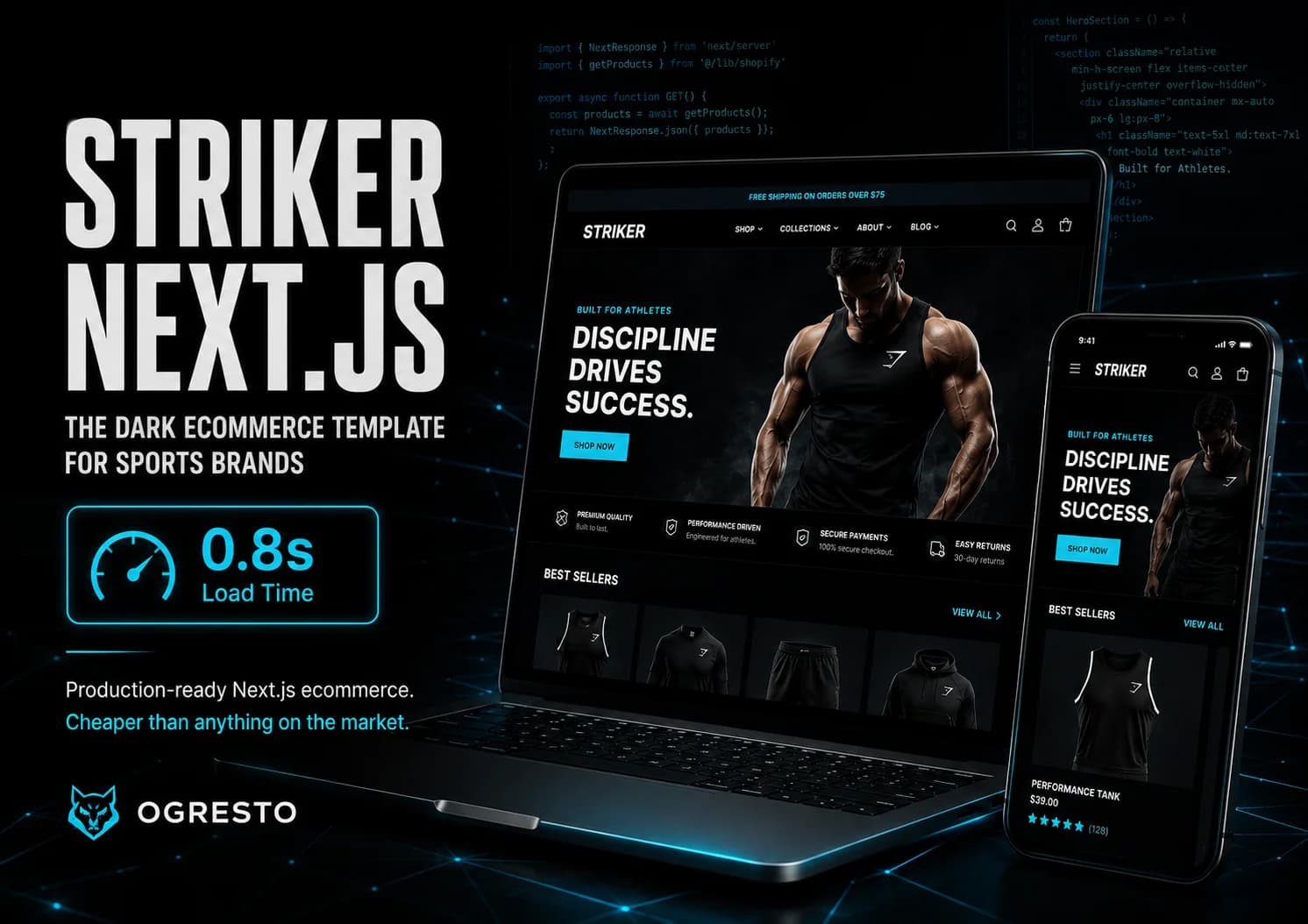
- Next.js with a premium template like Striker — 3-5 days to a working customised store
The template option deserves specific mention. A quality Next.js ecommerce template is not just a design shortcut — it is an architecture shortcut. All the routing, cart logic, mobile navigation, and component structure decisions have already been made and tested. You are buying back weeks of development time.
Which Framework Do We Build With at Ogresto?
We use Next.js for every ecommerce project we build at Ogresto. We have built stores on Next.js for clients ranging from D2C fashion brands to sports equipment retailers — and the SEO, performance, and developer experience advantages are consistent across all of them.
We also build and sell Next.js ecommerce templates. Our Striker template is built on Next.js 16 App Router with TypeScript and Tailwind CSS v4 — the most current Next.js architecture available. It reflects the exact stack we use for client work.
If you are trying to decide between Next.js and React for your ecommerce project, the answer is almost always Next.js. If you want help making that decision or building the store, our web development service covers both consulting and full builds.
Related Reading
Frequently Asked Questions
Yes, but it is not trivial. Next.js has a different routing system and data fetching model to plain React. A migration requires restructuring your application, not just adding a dependency. Better to start with Next.js if ecommerce is the goal.
Next.js adds concepts — server components, the App Router, layouts, loading states — that React does not have. The learning curve is real but manageable for any developer who already knows React. Most developers find that the productivity gains outweigh the learning investment within a few weeks.
Next.js deploys to Vercel with zero configuration and to any Node.js hosting provider with minimal setup. AWS, Google Cloud, Railway, Render, and self-hosted servers all work. Vercel is the easiest option and has the best Next.js-specific features since they built the framework.
No. React is the foundation that Next.js is built on. React itself is healthier than ever — the React team at Meta actively maintains it and the React 19 release brought significant improvements. The ecosystem around React (including Next.js) is larger than ever in 2026.
Discussion
Join the conversation